
The record
Three words, five seats
Some phrases begin as slogans and grow into questions of justice. “The world is bigger than five” is just such a phrase. The power of these words, repeated for years by President Recep Tayyip Erdoğan, lies in reducing a complex world order to a single question anyone can understand: Does making decisions about the world mean representing all of it?
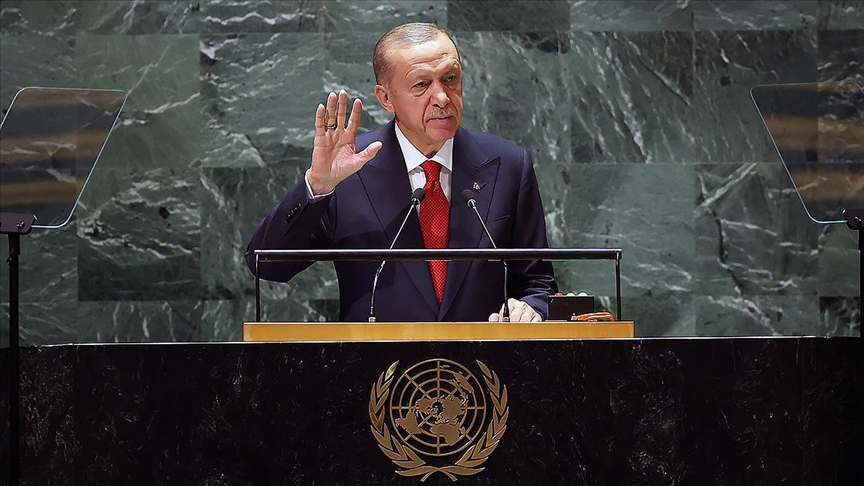
Erdoğan voiced that objection once again on 22 September 2026, from the podium of the 81st United Nations General Assembly. He criticised a conception of law that treats the powerful differently from the weak, and issued a clear warning about impunity: [1]
“Let it not be forgotten: an international system in which perpetrators get away with their actions, and impunity becomes commonplace, is doomed to decay.”
Recep Tayyip Erdoğan · 81st UN General Assembly · 22 September 2026
The speech concerned wars, international law and UN reform. But the principle it set out extends beyond that context. Because the story of money lost to the public raises the same question: To whom do those who wield power answer for its consequences?
A company paying billions of dollars in penalties makes an impressive headline. Which treasury receives that money is another story altogether.
This investigation pursues that second story. We are reading the ledger, not the headline.
The investigation in numbers
5: Permanent members of the Security Council with veto power.
$3.9 billion: The global financial penalties Airbus agreed with three countries in 2020.
€991 million: Airbus’s payment to the UK Treasury. Victim compensation sought: none.
$313 million: Total assets covered by arrangements for restitution from Switzerland to Uzbekistan.
$47.37 million: Cumulative expenditure reported by the Vision 2030 Fund as of 31 December 2025.
$52.88 million: Forfeited assets transferred from the United States to Nigeria.
230: Maternity and neonatal care centres equipped or upgraded in Uzbekistan.
All figures come from the documents and statements listed in the Sources section.
Record 01 · The lock held by the five
The five countries Erdoğan identifies are clear: the United States, China, Russia, France and the United Kingdom. On the 15-member Security Council, only these five permanent members have veto power. Even when the necessary majority is secured on a substantive matter, a negative vote by any one of the five can block a decision on its own. [2]
A less discussed detail lies in Article 108 of the UN Charter: for an amendment to the Charter to enter into force, the required ratifications must include those of all five permanent members. [3]
In other words, a world seeking to change the privileges of the five must still obtain their permission to do so within the existing system. The key to the lock remains in the pockets of those who fitted it.
The legal machinery of the fight against corruption is, of course, different. Security Council vetoes do not govern national prosecutors’ bribery cases. The connection lies elsewhere: on whose will do oversight of power and cooperation between states ultimately depend?
Record 02 · The geography of money
In a cross-border corruption case, the evidence may be in one country, the bank account in a second and the company’s true owner in a third. When the people behind shell companies cannot be identified, the money trail goes cold at that point. This is why the FATF places so much weight on transparency about “beneficial ownership”. [4]
The geography of corruption therefore includes where the money rests as much as where it originated. Accountability must be sought not only in the country where a bribe was paid, but also in the country where it was parked.
Record 03 · Airbus: The gap between the headline and the victim
The Airbus case is a textbook example of that gap.
In January 2020, the company agreed to financial penalties exceeding $3.9 billion in coordinated proceedings with authorities in the United States, France and the United Kingdom. The global resolution covered violations of US arms export regulations as well as foreign bribery cases. [5]
The agreement approved in the UK proceedings provided for approximately €991 million to be paid to the public treasury. Less often quoted lines of the same judgment said that no victim compensation had been sought under this agreement. The reasons included the difficulty of readily establishing quantifiable losses; potential victims retained the right to seek compensation separately. [6]
“A large penalty does not, by itself, show that a victim’s loss has been made good.”
This is where the distinction becomes decisive. Money entering the coffers of the state imposing the penalty and resources recovered by the society that suffered the harm belong in different columns of the same ledger. Reading the first column does not mean one has read the second.
Record 04 · Uzbekistan: From the press release to the accounts
The Uzbekistan case takes us from the wording of agreements to accounting records.
Switzerland and Uzbekistan arranged the restitution of approximately $131 million in 2022, followed by a further $182 million in February 2025, from assets confiscated in proceedings linked to Gulnara Karimova. The total of $313 million was intended to benefit the public through the UN-administered Uzbekistan Vision 2030 Fund. [7]
The fund’s 2025 financial report shows the different faces of that same money at different stages. As of 31 December 2025, deposits into the fund stood at $94.85 million; transfers to implementing organisations totalled $90.25 million; and reported cumulative expenditure was $47.37 million. [8]
These differences are not, in themselves, evidence of wrongdoing. Payment schedules and implementation over several years may explain why the figures advance in stages. But they also show why the statement “$313 million was returned to the people” needs a footnote: as of the reporting date, the amount recorded as expenditure was approximately 15 per cent of the total announced for restitution.
There are tangible outputs too. According to the fund’s activity report, 230 maternity and neonatal care centres were equipped or upgraded, and 50 schools were provided with digital technology. These are figures reported by the fund itself; the quality of the services and their lasting impact still require separate measurement. [9]
“The return of money can be marked by a date. Turning it into public benefit is a process that must be tracked.”
Record 05 · Nigeria: From a yacht to a light bulb
In Nigeria’s case, that process stretches from a luxury yacht to access to electricity.
An agreement signed between the United States and Nigeria in January 2025 provided for approximately $52.88 million in forfeited assets to be used for the public’s benefit. The assets included the 65-metre yacht Galactica Star and luxury properties in the United States. Of the funds, $50 million was allocated to electrification and approximately $2.88 million to criminal justice and counterterrorism capacity. The agreement also contained provisions for oversight and public reporting. [10]
The measure of success here is not the figure in the agreement, but the next column alongside it: homes connected to electricity, continuity of service and expenditure records.
There is also an important update concerning personal criminal liability in the case. Former Nigerian Petroleum Minister Diezani Alison-Madueke was acquitted of six bribery charges in a separate trial in London on 17 June 2026. The US asset forfeiture proceedings and the UK criminal trial concerning individual liability are independent processes. [11]
Journalism that demands accountability must record acquittals as carefully as convictions.
Timeline
January 2020: Airbus agreed to a global settlement exceeding $3.9 billion with the United States, France and the United Kingdom.
2022: Switzerland arranged the restitution of approximately $131 million to Uzbekistan.
January 2025: US-Nigeria agreement: $52.88 million in forfeited assets for the public’s benefit.
February 2025: A further $182 million from Switzerland. In the same month, Trump signed the executive order pausing FCPA enforcement.
June 2025: The US Department of Justice published new FCPA guidelines; the pause ended.
17 June 2026: Alison-Madueke was acquitted of six bribery charges in London.
9 July 2026: The OECD issued a due diligence warning concerning Türkiye.
22 September 2026: Erdoğan reiterated his warning about impunity at the 81st UN General Assembly.
Record 06 · Washington: A universal prohibition, a national scale
Another document testing Erdoğan’s call for “the same law for the powerful and the weak” comes from Washington.
Trump’s February 2025 executive order called for a pause, subject to exceptions, in new investigations and enforcement actions under the FCPA, a central tool in combating foreign bribery. The competitiveness of American companies and national security featured prominently in its rationale. [12] The pause ended with new guidelines published in June; but opportunities for American companies to compete and US security were now written into the enforcement priorities. The guidelines also stated that enforcement would not be based on nationality. [13]
Article 5 of the OECD Anti-Bribery Convention, meanwhile, is clear: investigations and prosecutions must not be influenced by national economic interests, relations with other states or the identity of the people involved. [14]
This comparison is not a definitive finding of a violation. But it raises an unavoidable question: how universal does a universal prohibition on bribery remain when weighed on the scales of national commercial interests?
Record 07 · Türkiye: The same yardstick, the same measure
The same standard applies to Türkiye.
On 9 July 2026, the OECD issued a due diligence warning concerning Türkiye. It listed shortcomings in corporate liability legislation, gaps in whistleblower protection and inadequate investigation of foreign bribery allegations. This was not an accusation against all Turkish companies; it was an assessment of the country’s enforcement framework. [15]
Taking Erdoğan’s words seriously as a universal principle requires putting this assessment on the table as well. Türkiye’s demand for international justice is strengthened by the transparency of its own institutions and their investigative capacity.
Accountability demanded abroad becomes a principle, rather than a slogan, when it is also practised at home.
The ledger of justice · Five questions
All these cases point to the same conclusion: justice can be accounted for through five questions. The substance of a press release depends on how many of them it answers.
01 · Who was held responsible?
02 · How much was recovered in assets?
03 · Where was the money transferred?
04 · How much was spent?
05 · Whose life changed, and how?
This is what a call for a “veto on impunity” means in concrete terms: decisions that can be explained, money that can be traced, independent oversight and citizens able to demand answers about results.
Final record · Light bulbs, not zeros
Erdoğan’s declaration that “the world is bigger than five” is a forceful challenge to privilege in global governance. Its lasting value lies in applying the same yardstick everywhere: from the decision-making rooms of major powers to corporate boardrooms, and from there to government expenditure records.
Because the true measure of recovered wealth is not the string of zeros in a press release. It is a working piece of medical equipment, a home with its lights on and a person able to demand accountability for them.
The world is bigger than five.
And no power should be too big to be held accountable.
What is this investigation based on?
The figures and quotations in this article are based on the documents and statements numbered below. Numbers in the text correspond to the source list.
This special report was prepared by The Ledgers. Acquittals are duly recognised, and the parties’ right to respond is preserved. © 2026 The Ledgers. May be quoted with attribution.
Based on reporting from: Türkiye Ministry of Justice — Press: Official account of President Erdoğan’s speech to the 81st UN General Assembly; UN Security Council — Voting system; Charter of the United Nations — Full text, Article 108; FATF — Beneficial ownership; US Department of Justice — Airbus global settlement (January 2020); Courts and Tribunals Judiciary of England and Wales — SFO v. Airbus SE judgment, paragraphs 95–96; Swiss Federal Department of Foreign Affairs (FDFA) — Asset restitution to Uzbekistan; UNDP MPTF — Uzbekistan Vision 2030 Fund, 2025 Consolidated Annual Financial Report; UNDP MPTF — Uzbekistan Vision 2030 Fund, 2025 Consolidated Annual Narrative Report; US Department of Justice — US-Nigeria asset transfer agreement (January 2025); 2 Hare Court — Acquittal of the former Nigerian Petroleum Minister (17 June 2026); White House — Executive order pausing FCPA enforcement (February 2025); US Department of Justice — FCPA investigation and enforcement guidelines (June 2025); OECD — Anti-Bribery Convention, Article 5; OECD Working Group on Bribery — Due diligence warning concerning Türkiye (9 July 2026).
Source documents
15- Türkiye Ministry of Justice — Press: Official account of President Erdoğan’s speech to the 81st UN General Assemblybasin.adalet.gov.tr
- UN Security Council — Voting systemmain.un.org
- Charter of the United Nations — Full text, Article 108un.org
- FATF — Beneficial ownershipfatf-gafi.org
- US Department of Justice — Airbus global settlement (January 2020)justice.gov
- Courts and Tribunals Judiciary of England and Wales — SFO v. Airbus SE judgment, paragraphs 95–96judiciary.uk
- Swiss Federal Department of Foreign Affairs (FDFA) — Asset restitution to Uzbekistaneda.admin.ch
- UNDP MPTF — Uzbekistan Vision 2030 Fund, 2025 Consolidated Annual Financial Reportmptf.undp.org
- UNDP MPTF — Uzbekistan Vision 2030 Fund, 2025 Consolidated Annual Narrative Reportmptf.undp.org
- US Department of Justice — US-Nigeria asset transfer agreement (January 2025)justice.gov
- 2 Hare Court — Acquittal of the former Nigerian Petroleum Minister (17 June 2026)2harecourt.com
- White House — Executive order pausing FCPA enforcement (February 2025)whitehouse.gov
- US Department of Justice — FCPA investigation and enforcement guidelines (June 2025)justice.gov
- OECD — Anti-Bribery Convention, Article 5legalinstruments.oecd.org
- OECD Working Group on Bribery — Due diligence warning concerning Türkiye (9 July 2026)oecd.org
File updates
Report published
Completed
Editorial research status recorded.
Editorial note
The publications used in this account are listed above.
Submit a response or correction ↗Reader comments
Verified members can comment. Comments appear after editorial approval. Please address the evidence and avoid personal information.
No published comments yet.
Sign in / Create account →Stay with the story.
Follow The Ledgers for new investigations, developments in our case files and videos.