The record
SICPA regained Türkiye’s tobacco and alcohol tax-stamp contract in 2014. Nearly four years later, the consultancy relationship behind that victory had become an open dispute. Letters exchanged in January 2018 offer the first inside account of how the relationship operated.
On one side was Switzerland-based SICPA; on the other, AviaLift LLC. Documents discussed in earlier instalments identify AviaLift’s sole authorised signatory as a businessman who signed emails for Lettra Teknoloji in 2014. The Swiss complaint alleges that the same person also held an authorised position at SICPA’s competitor Gate Elektronik. This report refers to him as (Y).
The correspondence indicates that SICPA supplied periodic reports to AviaLift based on its Turkish contract’s “net revenue”, and that invoices were issued against them. By 2018, the parties were disputing late reports, payment deadlines, VAT and revenue for two crucial periods.
The documents record a commercial dispute; they do not independently prove the parties’ allegations. But they sharpen the question running through this series: what service justified a commission contingent on winning a public tender, payable to a person linked to rival bidders?
What the documents show—and what they do not
This report draws on correspondence containing allegations exchanged between the parties. The principal findings and their evidential status are listed below so readers can distinguish the documented record from claims.
| Finding | Source | Status |
|---|---|---|
| The SICPA-Assan partnership won the 2014 tender; the five-year TRY 359,304,283 contract was signed on 9 December 2014 | EKAP 2014/81560; parliamentary document | Verified through public records |
| SICPA and AviaLift had a consultancy relationship tied to SICPA’s net revenue in Türkiye | Legal letter dated 17 January 2018 | Recorded in the document |
| AviaLift’s sole authorised signatory (Y) corresponded for Lettra in 2014 | 2014 emails; authorisation dated 21 May 2014 | Supported by documents |
| (Y) held an authorised position at rival bidder Gate Elektronik | Swiss complaint, 27 October 2025 | Complainant’s allegation |
| Reports were delayed, payment terms extended from 30 to 60 days, and VAT used to halt payments | Legal letter on AviaLift’s behalf | One-sided allegation; SICPA did not respond |
| The structure using a company outside Türkiye was requested by SICPA | Legal letter on AviaLift’s behalf | One-sided allegation; unverified |
| December 2014–May 2015 revenue was attributed to an “old contract” | AviaLift’s account of SICPA officials’ explanation | Unverified; contract dates requested |
Background: a contract battle from 2007 to 2014
SICPA entered Türkiye’s tax-stamp business through a partnership with Kibar Holding. The SICPA-Assan joint venture won the Turkish Revenue Administration’s tender in late 2006, securing a five-year contract for 2007–2012. The system tracks stamps affixed to tobacco products and alcoholic drinks through a central information system.
Gate Elektronik–Prooftag won the 2012 tender with a TRY 217 million bid, TRY 107 million below SICPA-Assan’s. SICPA-Assan challenged the award. An administrative court annulled it, and the Council of State upheld that ruling in 2013 by three votes to two.
Two tenders followed:
| Date | Tender (EKAP) | Bidders | Outcome |
|---|---|---|---|
| 3 February 2014 | 2013/193582 | SICPA-Assan; Gate Elektronik; Eksim | Cancelled for lack of valid bids |
| 9 September 2014 | 2014/81560 | SICPA-Assan–SICPA Security Solutions; Gate Elektronik–Arjowiggins Security; Narsistem; Gemalto; Ankaref | SICPA partnership won: TRY 359,304,283; signed 9 December 2014 |
Lettra Teknoloji appears among purchasers of the February tender specifications, but not among bidders. Kibar Holding sold its 50 per cent stake in the joint venture to its partner in 2015.
Part 1 described a complaint filed with Switzerland’s federal prosecutor on 27 October 2025. It alleges that consultancy agreements were signed with five people through Switzerland’s Trasseo Capital SA on 1 February 2014, two days before the February tender. The complainant alleges bribery and commission payments, bid rigging, forgery of official documents and forming an organisation to obtain unlawful gains. According to the complaint, SICPA SA also signed a consultancy agreement with AviaLift LLC on 27 May 2014 providing for the same commission rate.
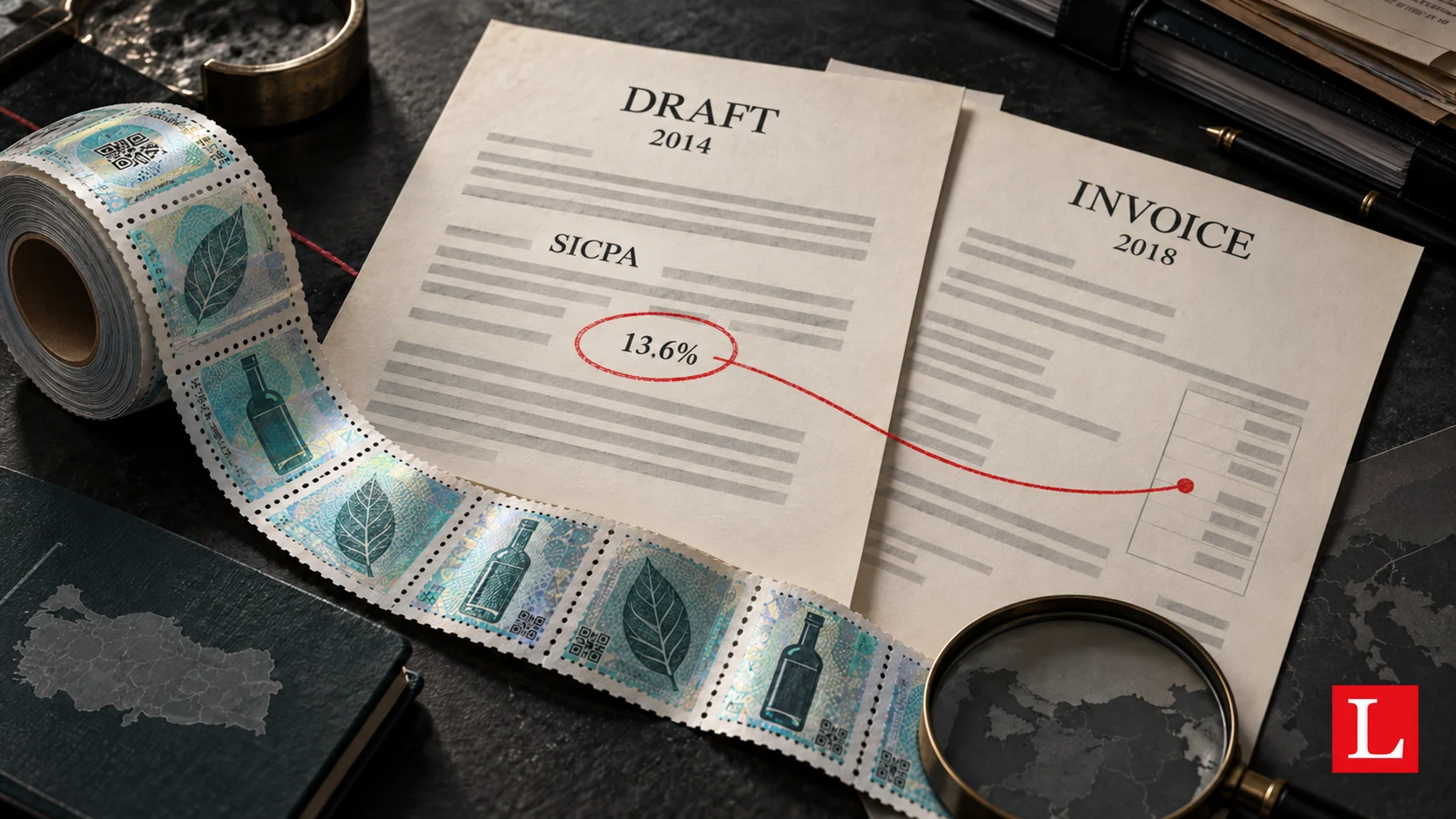
In Part 2, leaked contracts and emails showed payments totalling €450,000 to five people in February 2014, with confirmations circulated among SICPA executives. Those documents also show that a draft agreement between SICPA Security Solutions SA and Lettra circulated on 14 May 2014, providing for a 13.6 per cent success fee conditional on SICPA winning the new tender. A week later, an instrument authorising (Y) to enter contracts for AviaLift LLC inside and outside Türkiye was notarised in Forsyth County, Georgia, United States.
A draft escrow agreement between SICPA Security Solutions SA, AviaLift LLC and a Lausanne notary envisaged SICPA delivering cheques of up to €4.5 million to secure the consultant’s commission. The new documents take the story from the drafts of 2014 to the invoices of 2018.
January 2018: when the consultancy relationship broke down
The letter dated 17 January 2018 examined by The Ledgers was sent to SICPA by a legal adviser acting for AviaLift. It was addressed to SICPA executives Celine Haenny, Eric Corbier and Virginie Passerini. It answered a letter SICPA had sent AviaLift a week earlier, on 10 January.
The tone is forceful. AviaLift’s adviser says the relationship had previously functioned well, but “serious problems” subsequently arose. The letter attributes those problems to SICPA’s own conduct.
AviaLift’s central defence is simple: VAT is not the issue. The letter alleges that SICPA failed to meet contractual obligations and placed the VAT dispute ahead of those failings. AviaLift argues that a tax disagreement does not entitle SICPA to suspend reporting and payment obligations, and demands an immediate end to the practice.
The correspondence matters less for its complaints than for the relationship it reveals. An undated consultancy scope discussed in Part 2 listed “winning the tender” and “competitor information” among the consultant’s duties, deeming the assignment successfully completed when SICPA won. The 2018 letters provide the first concrete view of how such an arrangement operated after the award: reports, invoices and a payment schedule tied to SICPA’s Turkish revenue.
The money mechanism: net revenue reports, 30 to 60 days, and VAT
According to AviaLift, the consultancy agreement required SICPA to produce periodic “Net Revenue Reports”. These formed the calculation base for payments to AviaLift. The letter stresses that reporting should have been routine back-office work and alleges that delays effectively extended payment deadlines in SICPA’s favour.
“Net revenue” was already part of the file. In the May 2014 draft negotiations, SICPA proposed calculating the 13.6 per cent fee on net revenue with an annual TRY 40 million threshold; Lettra proposed TRY 35 million plus VAT. The reporting arrangement in the 2018 letters appears consistent with SICPA’s 2014 formula.
The second allegation concerns deadlines. AviaLift’s adviser says SICPA unilaterally extended the contractual 30-day payment period to 60 days. AviaLift objected, but the practice continued. The letter describes it as a unilateral amendment, breach of contract and arbitrary conduct.
The third issue is VAT. AviaLift’s reply suggests that SICPA wanted VAT amounts on past invoices refunded or the invoices amended. AviaLift accepts issuing future invoices without VAT but refuses to revise past invoices.
For a sense of scale, applying the 13.6 per cent rate—which the complaint says also appeared in the AviaLift agreement—to the full TRY 359.3 million contract value produces approximately TRY 48.9 million. Net revenue may differ from contract value, so the documents do not establish how much AviaLift actually received.
These details go beyond an ordinary collection dispute. They show revenue from SICPA’s Turkish public contract being converted, through regular reports, into a base for calculating a consultancy fee.
The foreign structure: why invoice from abroad?
The most striking allegation concerns invoicing. AviaLift’s adviser says SICPA requested that the relationship be conducted through a company outside Türkiye rather than a Turkish company. Had the Turkish company issued the invoices, the letter argues, the VAT then applicable would have been charged and the present dispute would never have arisen.
Read alongside the spring 2014 chronology, the allegation acquires new significance:
• 14 May 2014: the 13.6 per cent success-fee draft between SICPA Security Solutions SA and Lettra Teknoloji circulated. Lettra’s proposal included “plus VAT”.
• 21 May 2014: the instrument authorising (Y) to contract for AviaLift LLC was notarised in the United States.
• 27 May 2014: according to the Swiss complaint, SICPA SA signed an AviaLift consultancy agreement providing for the same rate.
Read together, the documents and complaint suggest that the fee negotiated with Lettra, for which (Y) corresponded, moved within two weeks to a foreign company of which (Y) was sole authorised signatory. If AviaLift’s 2018 allegation is correct, SICPA requested that move. The documents do not explain why.
The “Georgia” question. The letter argues that changing past invoices or refunding VAT amounts was impossible under the Georgian tax legislation governing them. This raises a new question. The Swiss complaint describes AviaLift as Atlanta-based; the authorisation was notarised in the US state of Georgia.
The United States has no VAT system. Which country the invoices were issued in, under which company name and which tax registration remain unanswered questions. Paying a commission tied to a Turkish public contract through a foreign company of a person linked to a competing bidder is among the structures attracting particular attention under international compliance standards.
The missing six months: December 2014–May 2015
Perhaps the most critical passage concerns revenue for December 2014–February 2015 and March–May 2015. AviaLift says no Net Revenue Reports were supplied for either period.
According to AviaLift, SICPA officials said the transactions belonged to an older SICPA contract and therefore fell outside the consultancy agreement. AviaLift rejected this and asked for the old contract’s start and end dates.
The dates matter. Public records show that the new five-year contract was signed on 9 December 2014. The disputed six months begin immediately afterwards.
An internal email discussed in Part 2 adds an unexpected detail. On the morning of 3 February 2014, the day of the subsequently cancelled tender, SICPA executive Bruno Frentzel predicted that the company would retain its existing position for another “10–15 months”, mentioning TRY 45 million for ten months. Counted from the tender date, that interval ends between December 2014 and May 2015: the same span SICPA later attributed to the “old contract”.
9 December 2014 · New contract signed
No report supplied, according to AviaLift.
The dashed line marks the new contract’s signature; the two highlighted bars show periods for which AviaLift says it received no net revenue report.
This overlap permits two readings:
1. There was an interim arrangement. After the February tender’s cancellation, SICPA may have continued the service under an interim contract or extension remaining in force for several months after the new contract was signed. Its answer to AviaLift could then be technically correct. But the question remains: under which contract, procedure and price did Türkiye’s Revenue Administration receive services during those six months?
2. The new contract took effect on signature. In that case, attributing the revenue to an “old contract” may have reduced the consultant’s share.
Whichever reading is correct, the public is entitled to know which contract underpinned a service awarded through public procurement.
What was the success fee for?
The central question is straightforward: what service justified a commission contingent on winning a public tender, paid to someone linked to rival bidders?
The documents place (Y) in several roles simultaneously:
• He signed emails for Lettra Teknoloji in 2014. In an email dated 24 February, he said he used his Gate email address “only for the Turkish Identity Card project”.
• The Swiss complaint alleges that he owned Lettra and held an authorised position at Gate Elektronik.
• Documents discussed in Part 2 identify him as one of five people with Trasseo Capital SA consultancy agreements dated 1 February 2014.
• From 21 May 2014, he was AviaLift LLC’s sole authorised signatory.
In a note dated 30 May 2014, then SICPA-Assan general manager Hakan Arıkan also described Lettra, which attended the Revenue Administration’s draft-specification consultation, as “a second company participating on behalf of Gate”. Gate was SICPA’s principal rival: the winner in 2012, a bidder in February 2014, and a losing bidder with Arjowiggins Security in September 2014.
What does the law say? Article 235 of Türkiye’s Criminal Code punishes bid rigging in public procurement with three to seven years’ imprisonment. Paragraph 2(d) includes open or secret agreements between actual or prospective bidders to influence tender conditions, particularly price. Article 17 of Public Procurement Law No. 4734 also prohibits interference with procurement and conduct affecting competition or the award decision.
Under Article 66 of the Criminal Code, offences carrying a maximum sentence exceeding five but below twenty years have a fifteen-year prosecution limitation period. Because the maximum for bid rigging is seven years, that period has not yet expired for events dating to 2014.
International competition authorities recognise this structure. US Justice Department Antitrust Division guidance says competitors agreeing not to bid or to submit a losing bid often receive subcontracts or supply contracts from the winner in return. It identifies work awarded by a winner to losing competitors in the same tender as a typical warning sign.
What the documents do not show. They do not establish how Gate’s September bid was prepared, whether (Y) had decision-making authority over it or what services AviaLift actually delivered. No correspondence directly records an agreement on bid prices. The Ledgers does not accuse other bidders of wrongdoing merely because they participated.
But the documents establish a structure: a company whose sole authorised signatory was linked to the rival bidding side was the creditor of a commission paid by the winner and tied, in the 2014 drafts, to winning the tender. Its legal character is for the prosecutor examining the Swiss complaint, and if necessary Turkish authorities, to determine.
SICPA’s compliance record: from Switzerland to Brazil
SICPA’s corruption-related record takes these questions beyond an ordinary commercial dispute.
On 27 April 2023, Switzerland’s Office of the Attorney General convicted SICPA SA of corporate criminal liability connected with corruption. The decision relied on Article 102(2) of the Swiss Criminal Code and Article 322septies on bribery of foreign public officials. For failing to take organisational measures to prevent bribery in Brazil, Colombia and Venezuela, the company received a CHF 1 million fine and a CHF 80 million compensatory claim: CHF 81 million overall.
Prosecutors identified shortcomings in governance, risk management and compliance. A former sales director received a suspended 170-day prison sentence for bribing senior local officials in Colombia and Venezuela in 2009–2011. Proceedings against CEO and principal shareholder Philippe Amon were discontinued; prosecutors allocated part of the procedural costs to him.
SICPA did not appeal but said it disagreed with the grounds. It maintained that it was unaware of the conduct at the time and punished those responsible when it learned of it.
In Brazil, SICPA and Ceptis signed a leniency agreement worth approximately 762 million reais with oversight body CGU and the government’s legal representative AGU on 8 June 2021. It concerned improper payments to a public official between 2009 and 2015.
As Part 1 reported, countries identified by Swiss investigative platform Gotham City in 2019 in connection with the SICPA file included Togo, Ghana, the Philippines, Egypt, India, Kazakhstan, Colombia, Nigeria, Pakistan, Senegal, Vietnam, Venezuela, Ukraine and Brazil. Türkiye appears neither in that list nor within the 2023 ruling, which is not a judgment on the Turkish allegations.
The timing is striking. The Brazilian payments covered 2009–2015; the Trasseo payments, Lettra draft and AviaLift arrangement in Türkiye date to 2014. The Swiss investigation lasted eight years and ended in 2023. The 2018 correspondence shows SICPA discussing payments under a consultancy tied to the Turkish tender while that investigation was ongoing.
An unavoidable question follows: during the years when prosecutors identified governance, risk and compliance deficiencies, did SICPA’s compliance unit know of this consultancy relationship in Türkiye—and, if so, how did it assess it?
Red flags: what international standards say
Compliance programmes require additional scrutiny when certain signs appear in third-party relationships. The DOJ–SEC anti-corruption guide and the Antitrust Division’s bid-rigging guidance provide two familiar lists. The table compares those signs with the records in this file.
| Warning sign | Source | Fact requiring examination |
|---|---|---|
| Excessive commissions to third-party agents or consultants | FCPA Guide | 13.6 per cent of public-contract net revenue; draft escrow cheques up to €4.5 million securing the commission |
| Consultancy contracts with vaguely described services | FCPA Guide | February 2014 payments described as “open-ended loans” in a Trasseo email and a “consultancy agreement” in a bank instruction; complaint alleges services were not directly related to the tender |
| Shell company in an offshore jurisdiction or request for payment to a foreign account | FCPA Guide | AviaLift’s operations are unclear from the documents; according to AviaLift, the Turkish-contract commission was invoiced through a foreign company at SICPA’s request |
| Winner awards work to losing competitors in the same tender | DOJ Antitrust guidance | AviaLift, whose signatory (Y) corresponded for Lettra and allegedly held authority at Gate, was creditor of a commission tied to winning bidder SICPA’s Turkish revenue |
None of these signs alone proves a crime. That is why compliance programmes provide for third-party due diligence and approval mechanisms. What checks SICPA conducted on AviaLift are unknown; the company left our earlier AviaLift questions unanswered.
How this report was prepared
The Ledgers examined correspondence dated January 2018. Dates and party details were compared with the 2013–2014 records used in earlier instalments and public procurement records.
Legal letters reflect the writer’s position at the time. The allegations reported here are AviaLift’s allegations from 2018; SICPA’s response to them has not been obtained.
AviaLift’s sole authorised signatory is called (Y) solely for anonymisation. This does not assert that he is the unidentified “Y” mentioned in the February 2014 email discussed in Part 2. The legal adviser’s name is withheld because publishing it was not considered necessary in the public interest.
This report declares no one guilty. It brings the questions raised by the documents to the attention of the public and the competent authorities.
Based on reporting from: The Ledgers · Part 1, 19 September 2026; The Ledgers · Part 2, 1 October 2026; Swiss Office of the Attorney General · SICPA corporate criminal liability, 27 April 2023; Radio Lac · SICPA conviction; The Exchange · SICPA criminal liability; Money Times · SICPA and Ceptis leniency agreement, 8 June 2021; US Department of Justice / SEC · FCPA Resource Guide, second edition, 2020; US Department of Justice · Price Fixing, Bid Rigging, and Market Allocation Schemes; Turkish Criminal Code No. 5237 · Articles 235 and 66.
Source documents
09- The Ledgers · Part 1, 19 September 2026theledgersnews.com
- The Ledgers · Part 2, 1 October 2026theledgersnews.com
- Swiss Office of the Attorney General · SICPA corporate criminal liability, 27 April 2023agov.admin.ch
- Radio Lac · SICPA convictionNo public link supplied
- The Exchange · SICPA criminal liabilityNo public link supplied
- Money Times · SICPA and Ceptis leniency agreement, 8 June 2021No public link supplied
- US Department of Justice / SEC · FCPA Resource Guide, second edition, 2020No public link supplied
- US Department of Justice · Price Fixing, Bid Rigging, and Market Allocation SchemesNo public link supplied
- Turkish Criminal Code No. 5237 · Articles 235 and 66No public link supplied
File updates
Report published
Editorial note
The publications used in this account are listed above.
Submit a response or correction ↗The records are in hand. The investigation continues.
The eight pages of the scan supplied for Part 3 appear below. All content has been permanently obscured; readable copies and download links are not provided.








We have thousands of documents. We are continuing to examine them.
The LedgersReader comments
Verified members can comment. Comments appear after editorial approval. Please address the evidence and avoid personal information.
No published comments yet.
Sign in / Create account →Stay with the story.
Follow The Ledgers for new investigations, developments in our case files and videos.